
Compliance Corner [August 2026]
Here is what is new in August 2025
It Pays to Comply
The EEOC in 2025 recorded its highest-ever recovery of settlements - i.e., employer payments in lieu of going to trial – in 2025. US employers paid the agency $528 million, including the following figures for workers:
$52.5 million in compensation for workers through conciliation, an increase of 24 percent over 2024, and
$55 million for workers as a result of investigations conducted, an increase of 115 percent over 2024.
Overall, $660 million was paid to 17,680 individuals who experienced discrimination.
I-9 Technical Violations Become “Substantive” Violations
In March, ICE reclassified several of what were classified as “Technical” violations on I-9 forms to “Substantive” violations – without providing notice to employers. What were “routine paperwork errors” that had a 10-day window for correction now require immediate correction and will likely entail a fine as well. Following is the list of violations that were previously classified as “Technical” and are now classified as “Substantive”:
Missing date of birth (Section 1)
Missing date of hire (Section 2)
Failure to date Section 1
Failure to date Section 2 Certification
Missing rehire date (Supplement B)
Spanish-language Form I-9 used outside Puerto Rico
Preparer/translator errors (missing name, address, signature, or date in Supplement A)
Missing employer/rep title (Section 2)
Missing document info despite retaining legible photocopy
Employers are cautioned to pay special attention to all new I-9 forms being completed.
Washington State Chatbot Law
In a first of its kind, the state of Washington has enacted a “Chatbot Disclosure Act” for the protection of its citizens. This act requires that people or entities who operate AI “companion chatbots” to provide “clear and ongoing disclosure” to anyone using their chatbots that they are indeed communicating with automated devices or systems and not with humans. More rigorous standards are in place for chatbots that either are aimed at minors or are likely to be used by minors, or if the providers are aware that users are minors. For example, chatbot operators who are aware of or are targeting minor users must implement reasonable measures to prevent chatbots from deploying manipulative engagement techniques. An example of such techniques could be praising a minor user for returning to the chatbot for emotional support. (Chatbots have already been found to induce minors to commit suicide, for instance.)
The definition of “companion chatbot” is important in this case. The following are NOT considered to be companion chatbots:
Bots used only for a business’s operational purposes;
Bots that are features of a video game or gaming application, so long as the bot does not discuss certain sensitive topics (i.e., suicide, self-harm, mental health);
A stand-alone electronic device that primarily functions as a voice command interface; and
Specific educational tools that are curriculum-focused.
The Chatbot Disclosure Act is scheduled to become effective on January 1, 2027.
Washington State Deepfake Protection Coming Soon
Effective June 11, 2026, Washington state will expand its current property rights law to include a person’s “digital likeness.” The law will forbid the use of such a likeness/image of a person without that person’s consent. This is to include both video and audio likenesses. (It would appear to be an idea whose arrival is timely.)
Transgender Case
A transgender nurse in Philadelphia was terminated for “serious deficiencies in performance that created a risk to patient safety,” according to court documents. In response, the nurse filed charges of “alleged discrimination, retaliation and a hostile work environment” under Title VII and related Pennsylvania and Philadelphia regulations. However, the nurse did not inform management of the alleged harassment promptly and consequently was terminated for the above performance issues by the VP of Patient Care Services while HR was still conducting its investigation. The judge ruled that management (i.e., the VP) was not aware of the nurse’s claim of mistreatment until after the performance issues had caused the decision to terminate to be made. The nurse had been placed on a Performance Improvement Plan three years prior to the termination, but the performance issues had continued, jeopardizing patient safety. The judge therefore ruled that the termination was justified and not protected under Title VII.
NEW Restrictions on Employment Checks in New York State
ALREADY EFFECTIVE, employers in New York State are prohibited from requesting or using consumer credit history for employment decisions, including hiring, compensation and other terms of employment. The only exceptions are narrow, and they are the following:
Positions where credit checks are required by state or federal law.
Law enforcement and peace officer roles.
Roles with signatory authority over funds or assets of $10,000 or more.
Positions involving access to trade secrets or national security information.
Roles responsible for managing or modifying digital security systems.
New Insurance Plan Limits Coming for 2027
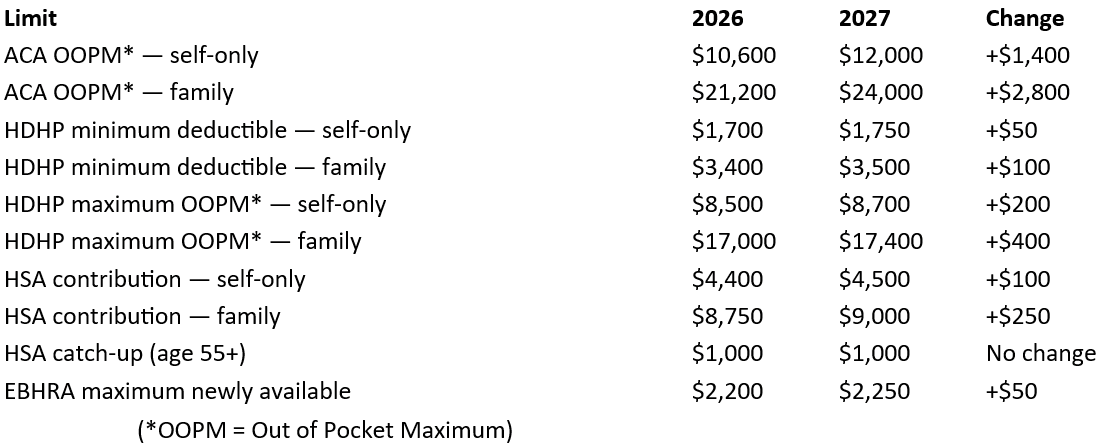
For high-deductible health plans (HDHPs), the minimum deductible will be $1750 (up from $1700 in 2026) for individuals and $3500 (up from $3400) for families.
The maximum out-of-pocket amounts in 2027 will be $8700 (up from $8500) for individuals and $17,400 (up from $17,000) for families. (Those figures exclude premiums.)
The 2027 contribution limits for Individual Health Savings Accounts (HSAs) will be $4500 for self-only coverage and $9000 for family coverage (up from $4400 and $8750, respectively, in 2026).
Virginia Enacts New Paid Sick Leave Law for 2027
The law initially applies initially to large employers, but rapidly extends to smaller employers as follows:
Effective July 1, 2027, employers with 50 or more employees,
Effective January 1, 2028, employers with 25 or more employees, and
Effective January 1, 2029, employers with ONE or more employees.
What is not clear at this time is whether the employee count includes Virginia employees only or employees in other states as well.
The accrual rate is to be one hour of leave for every 30 hours worked, beginning upon employment. Accrued but unused leave may be carried over from year to year, but only to a total accrual of 40 hours, unless the employer sets a higher limit. Alternatively, employers may credit employees with 40 hours at the beginning of the year, in which carryover of unused leave is not mandated. Further, employers need not pay out accrued, unused leave upon separation. However, if an employee is rehired within 12 months, previously accrued leave must be reinstated, unless it was paid out at separation.
Coverage applies to immediate and vertical extended family (e.g., grandparents through children) but not distant relatives, such as aunts, uncles or cousins, unless they act in a parental role.
Further Virginia Legal Updates Effective 7/1/26
NON-COMPETE AGREEMENTS
Prior law dictated that non-compete agreements could not be enacted for salaries under 78k. Now, no new non-competes will be enforceable after 7/1/26. The only allowable exception is that severance that must be formalized at the time of signing of a non-compete agreement. The law does contain an exception for termination for cause. However, “For Cause” is not defined in the legislation, and no required amount of severance is specified. Consequently, for employers, it will be critical that termination notices be issued for all terminations after 7/1/26.
Multi-State Employers - Out of state employers with VA employees and VA employers with out of state employees will probably all be covered, but the laws of the state of location of worker will govern if there is a conflict. No case law is yet in place, so this may vary somewhat.
NON-SOLICITATION - Former employees classified as “low-wage” (salary under $78k) cannot be bound by a non-solicitation clause after termination. The available alternative is a “non-interference” clause, which could provide for protection of proprietary information.
VIRGINIA WAGE PAYMENT ACT
Prior legislation excluded commissions, bonuses, etc., per the Virginia Supreme Court of Appeals. A new law proposed under House Bill 238 includes a MUCH broader definition of wages as “Any remuneration owed to employee” will broaden case law to include that formerly-excluded compensation AND impose treble damages if malice is involved; base award = 2x damages PLUS attorney’s fees
It is therefore IMPORTANT for employers to clarify terms of bonuses & commissions. That legislation also covers independent contractors, so a possible tactic for terminated employees is to go to district court to make a quick hit against the employer. It was noted that severance tied to performance is quite “risky” because it is generally tied to wages and therefore should be treated similarly.
WAGE TRANSPARENCY and OTHER REQUIREMENTS – EFFECTIVE 7/1/26
Following the lead of Colorado and other states, Virginia will no longer allow any request for prior salary information. Further, effective 7/1/26, good faith ranges will be required in postings. Labor attorneys think that questions about a “desired range” of compensation will probably be allowable. A 15-day “correction period” will be allowed in case someone finds a posting without the required range information.
While requesting prior compensation information is not allowed, voluntary revelation of earnings by an applicant is not a violation of transparency law. Bonus/commission plans MUST be clearly stated.
All current wage/benefit plans are now subject to the new law; violations will be subject to enhanced penalties.
Stated ranges are not automatic caps; employers can offer more than the range maximum for exceptional candidate(s), but then they should review range to see if it needs to be updated
VIRGINA PAID FAMILY & MEDICAL LEAVE ACT
VA is now the 14th state to enact its own Paid FMLA law. This is a “wide-ranging” law in terms of its coverage. Contributions will be shared between employers and employees via taxes and payroll deductions.
Virginia employers with employees in other states will have to find out and then specify which state law applies to those employees. NOTE: Unlimited PTO does not affect FMLA.
The Virginia version of FMLA similar to the Federal law; the only difference is in the pay component.
VA Paid FMLA to take effect in 2029 after taxes build up funds.
VA SICK LEAVE REQUIREMENT
Virginia has increased the mandated amount of sick leave per employee to 40 hours/year (Standard), THEREFORE, companies that have “bucket” time off (e.g., unlimited PTO, etc.) should examine their policies to ensure proper compliance and coordination. The FINAL version of this law is yet to be determined (e.g., definition of wages), but that is expected in the short term. This program will be managed as a state program; claims will be scrutinized.
EEOC Issues New National Enforcement Plan (NEP) for 2025-2029
On June 4, the EEOC issued a new enforcement program for 2025-2029, immediately rescinding the Biden-era plan that was scheduled to run through 2028. The NEP guides the agency’s work across outreach, public education, technical assistance, enforcement and litigation. The stated priorities are the following:
remedying race and sex discrimination related to diversity, equity and inclusion (DEI or similar) efforts;
protecting American workers from anti-American national origin discrimination;
defending women’s rights to single-sex spaces at work and workers’ rights to express the “binary nature of sex”; and
protecting workers’ religious liberty rights to receive accommodations and be free from religious discrimination, harassment and related retaliation.
Recommendations for employers are the following:
Audit programs and policies,
Review job postings and recruiting materials,
Assess immigration and visa-related hiring practices,
Exercise caution when navigating religious accommodation requests (includes having good documentation).
DC Minimum Wage Increase
Effective July 1, the minimum wage in the District of Columbia was increased to $18.40 per hour, for a straight-time year’s employment total of $38,272.
New Privacy Law in Vermont
22 states already had privacy laws in place, but Vermont’s deserves notice because it has lower thresholds for violations to be determined. For example, the requirements for protecting consumer health data are tighter than those that are in place elsewhere and require specific consent for distribution. It is being compared to similar Connecticut laws, which are described as being “at the more aggressive end of the state consumer privacy law spectrum.” Employers with Vermont employees are advised to review the law carefully to ensure compliance.
PCORI Fees Were Due July 31 (Self-Insured Plans)
The Patient-Centered Outcomes Research Institute (PCORI) fee is an annual fee imposed on health insurance issuers and sponsors of self-insured health plans. This fee helps fund research aimed at improving healthcare outcomes. For plan years ending on or after October 1, 2025, and before October 1, 2026, the PCORI fee is set at $3.84 per covered life. For insured plans, the carrier normally handles the calculation and payment of the fee, but for self-insured plans, the employer is responsible.
The total PCORI fee is calculated based on the average number of lives covered during the policy or plan year, multiplied by the applicable dollar amount. Employers can use one of several methods to determine the average number of covered lives. These are the “Actual count method,” the “Snapshot method,” and the “Form 5500 method.”
Current and Pending Federal Healthcare Limits
Following are the current and upcoming healthcare figures determined by the Federal Government:
Common Form 5500 Mistakes Plan Sponsors Should Avoid
Mistakes on the Form 5500 can lead to significant daily penalties, but most are preventable. Frequent errors include failing to file when required, inaccurate participant counts, missing Schedule A data and misapplying Schedule C requirements. Plan sponsors are advised to verify participant counts, track carrier data proactively and file extensions when needed to avoid costly compliance issues.